Choosing between Google Ads vs Meta Ads is a common challenge for businesses investing in digital marketing. Both platforms can generate leads, increase sales and help businesses grow, but they work in different ways.
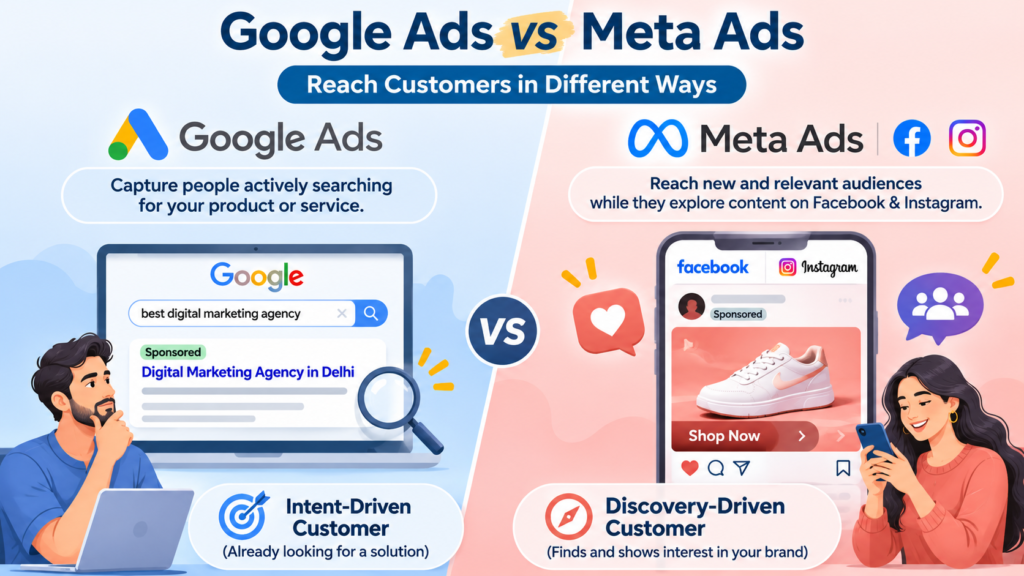
Google Ads helps you reach people actively searching for products or services. Meta Ads helps you reach potential customers through platforms such as Facebook and Instagram, even when they are not actively looking to buy.
For example, someone searching for “best digital marketing agency in Delhi” may be ready to contact an agency. Someone scrolling Instagram might discover an agency after seeing its content or advertisement.
So, which platform should your business choose? The answer depends on your target audience, product, customer behaviour, advertising budget and business objectives.
1. What Are Google Ads?
Google Ads is Google’s online advertising platform that allows businesses to display paid advertisements across Google’s network.
Businesses can reach potential customers through search results, YouTube, websites, Google Shopping and other placements.
The most common campaign types include:
Search Ads: Text advertisements displayed when users search for relevant keywords.
Display Ads: Image advertisements shown across websites and apps.
Shopping Ads: Product advertisements displaying images, prices and product information.
Video Ads: Advertisements shown on YouTube.
Performance Max: Campaigns that use Google’s advertising inventory and automation to optimise towards conversion goals.
Example: A person searches for “website development company in Delhi”. Your business can appear in the sponsored search results if your campaign targets relevant searches.
Best suited for: Businesses offering services or products that customers actively search for, such as healthcare, education, professional services, repairs and specialised products.
2. What Are Meta Ads?
Meta Ads is the advertising platform used to promote businesses across Facebook, Instagram, Messenger and other Meta placements.
Unlike search advertising, Meta Ads generally reaches people based on audience characteristics, interests, behaviours and other targeting signals.
Popular Meta advertising formats include:
Image Ads: Single-image advertisements for products, services and offers.
Video Ads: Short videos that demonstrate products or explain services.
Carousel Ads: Multiple images or videos displayed in one advertisement.
Reels and Stories Ads: Full-screen vertical advertisements.
Lead Ads: Forms that allow users to submit their contact details.
Click-to-WhatsApp Ads: Advertisements that encourage users to start a WhatsApp conversation.
Example: A jewellery brand can display a new bridal collection to people interested in fashion, weddings and jewellery. Users may discover the collection while scrolling Instagram and decide to purchase.
Best suited for: E-commerce, fashion, beauty, food, lifestyle brands, events and businesses that benefit from visual storytelling.
3. Google Ads vs Meta Ads: Key Differences
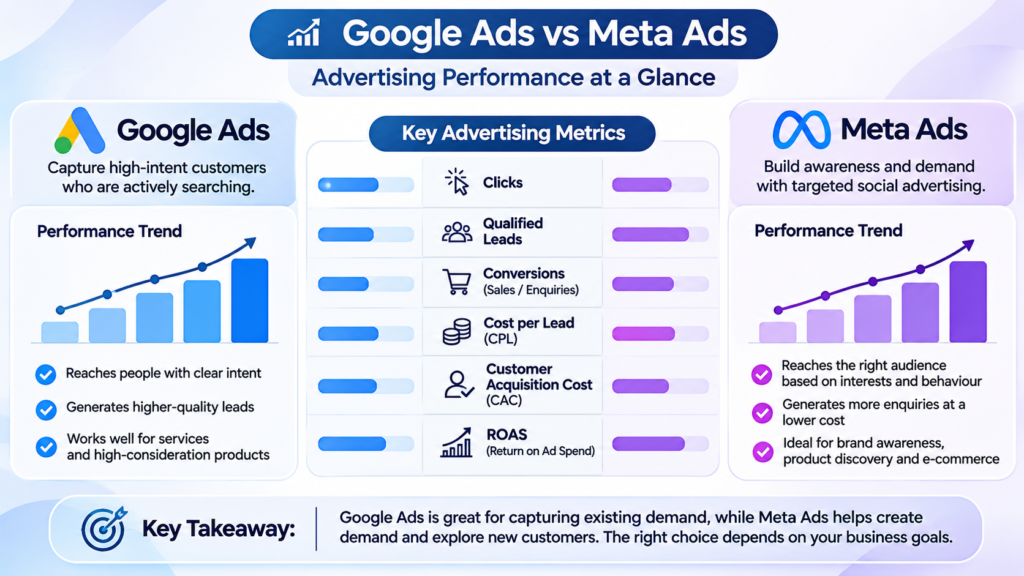
The biggest difference is how each platform reaches potential customers.
| Comparison | Google Ads | Meta Ads |
|---|---|---|
| Main approach | Captures existing demand | Creates and develops demand |
| Audience behaviour | Actively searching | Browsing social platforms |
| Targeting | Keywords, location and audience signals | Demographics, interests and behaviours |
| Popular formats | Search, Shopping, Display and Video | Images, Reels, Stories and Carousels |
| Creative requirements | Strong keywords and relevant ad copy | Engaging visuals and compelling copy |
| Lead generation | Often strong search intent | Lead forms and WhatsApp enquiries |
| E-commerce | Search and Shopping campaigns | Product discovery and retargeting |
| Best use | Reaching people looking for a solution | Introducing products and building interest |
One important distinction: Google Ads is not limited to search advertisements, and Meta Ads is not limited to awareness. Both platforms support different campaign objectives and can contribute to multiple stages of the customer journey.
4. Which Platform Is More Cost-Effective?
Advertising costs depend on competition, industry, location, audience, campaign objective, ad quality and conversion performance.
Google Search clicks can be expensive in competitive industries such as finance, insurance and legal services. Meta can often generate cheaper clicks or enquiries, but those enquiries may require more follow-up before becoming customers.
There is no fixed cost that applies to every Indian business.
Consider this illustrative example:
| Metric | Google Ads | Meta Ads |
|---|---|---|
| Monthly ad spend | ₹20,000 | ₹20,000 |
| Leads generated | 40 | 80 |
| Cost per lead | ₹500 | ₹250 |
| Customers acquired | 8 | 5 |
| Cost per customer | ₹2,500 | ₹4,000 |
In this example, Meta generates twice as many leads at half the cost per lead. However, Google generates more customers at a lower acquisition cost.
This demonstrates why businesses should not judge advertising performance only by clicks or leads.
Important metrics to monitor:
CPC (Cost Per Click): How much you pay for each click.
CPL (Cost Per Lead): How much you spend to generate an enquiry.
CAC (Customer Acquisition Cost): How much it costs to acquire a paying customer.
Conversion Rate: The percentage of visitors who complete a desired action.
ROAS (Return on Ad Spend): Revenue generated for every rupee spent on advertising.
For e-commerce businesses, also consider product margins, average order value, returns and repeat purchases. A high ROAS does not automatically mean a profitable campaign.
5. Which Platform Is Better for Different Businesses?
The right platform depends on how customers discover and purchase your product or service.
| Business Type | Recommended Starting Platform | Reason |
|---|---|---|
| Local service businesses | Google Ads | Customers often search for nearby services |
| Hospitals and clinics | Google Ads | People actively search for treatments and specialists |
| Fashion and jewellery | Meta Ads | Visual products benefit from Reels and product creatives |
| E-commerce brands | Both | Meta supports discovery; Google captures product searches |
| Coaching institutes | Both | Search demand and social campaigns support admissions |
| Real estate | Both | Meta builds interest; Google captures property searches |
| B2B services | Google Ads | Buyers often search for specific business solutions |
| Restaurants and cafés | Both | Google captures local searches; Meta promotes offers and new launches |
Example: An E-commerce Jewellery Brand
Imagine an online jewellery brand selling artificial jewellery across India.
Meta Ads can introduce new collections through Instagram Reels, product videos and carousel advertisements. These creatives can attract people who may not have known about the brand.
Google Ads can help reach customers searching for terms such as “buy kundan necklace online” or “artificial bridal jewellery”.
A combination of both platforms can support product discovery, purchase intent and remarketing.
6. Can You Use Google Ads and Meta Ads Together?
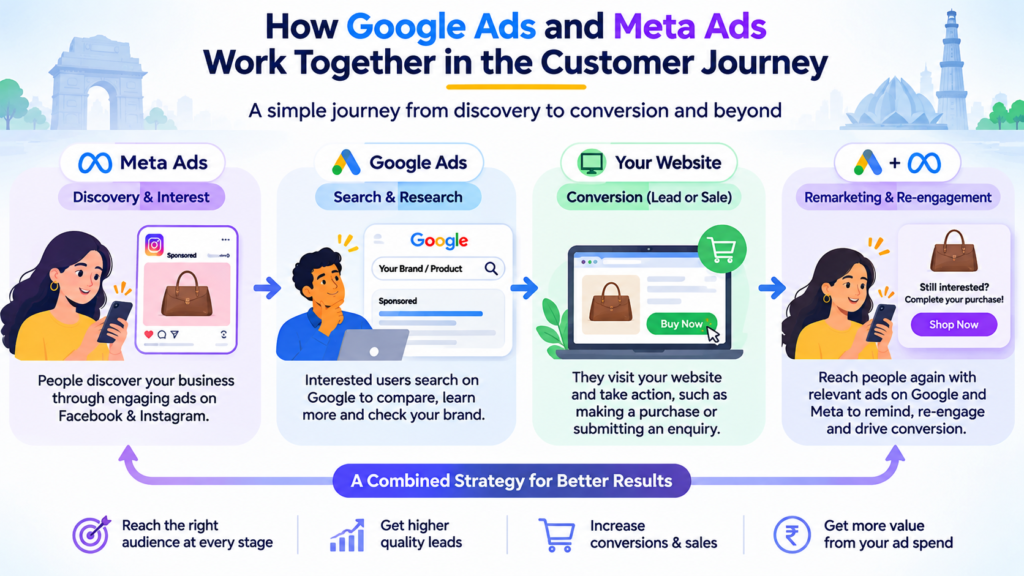
Yes. In fact, using both platforms can create a more complete customer acquisition strategy.
Instead of treating Google Ads vs Meta Ads as an either-or decision, consider how they can work together.
A typical customer journey may look like this:
Step 1: Discovery through Meta Ads
A potential customer sees your Instagram Reel, product advertisement or promotional offer.
Step 2: Research through Google
The customer searches for your brand, product or service to compare available options.
Step 3: Conversion
The customer visits your website, contacts your business or completes a purchase.
Step 4: Remarketing
If the customer does not convert immediately, relevant remarketing campaigns can encourage them to return.
However, combining both platforms does not mean splitting your budget equally. Start with the platform that best matches customer behaviour and expand once you have reliable conversion data.
7. How Should You Choose the Right Platform?
Before investing in advertising, answer these five questions:
Are customers already searching for your product or service? If yes, Google Search Ads may be a strong starting point.
Does your product depend on visual appeal? If yes, Meta Ads can help generate interest through images and videos.
Do you need enquiries or online purchases? Choose campaign objectives based on the actual business outcome.
Can your website convert visitors? A poorly designed website or unclear offer can waste advertising spend on either platform.
Can you track actual sales? Set up conversion tracking and connect lead or sales data wherever possible.
For businesses with limited budgets, avoid spreading your spending across too many campaigns. Test one focused strategy, measure results and scale what works.
Conclusion: Google Ads vs Meta Ads — Which One Should You Choose?
There is no universal winner in the Google Ads vs Meta Ads comparison. Both platforms solve different marketing problems.
Choose Google Ads when customers actively search for your products or services and you want to capture existing demand.
Choose Meta Ads when your business needs to introduce products, build interest, reach new audiences or promote visually appealing offers.
For many growing businesses, the strongest long-term strategy is to use both platforms with clearly defined roles. The key is to measure qualified leads, customer acquisition cost, revenue and profitability rather than focusing only on clicks or impressions.
At SocialGrowUp, we believe successful advertising starts with understanding customer behaviour and choosing the right strategy—not simply spending more on ads.
Frequently Asked Questions
1. Is Google Ads better than Meta Ads?
Google Ads is often better for reaching customers who are actively searching for a solution. Meta Ads is often better for product discovery, audience engagement and visual promotion. The right choice depends on your business objectives.
2. Which is cheaper, Google Ads or Meta Ads?
Meta Ads often generates cheaper clicks, but this does not guarantee cheaper customers. Compare cost per qualified lead, customer acquisition cost and return on ad spend to identify the more cost-effective platform.
3. Which platform is better for small businesses in India?
Google Ads can work well for small businesses offering services that customers actively search for. Meta Ads can be a strong option for local promotions, visual products and businesses that rely on social discovery.
4. Can beginners run Google Ads and Meta Ads?
Yes. Both platforms provide campaign creation tools, targeting options and performance reports. However, effective advertising requires keyword research, audience selection, creative testing, conversion tracking and budget optimisation.
5. Should I run Google Ads and Meta Ads at the same time?
You can run both when your budget, tracking and marketing strategy support it. Start with the platform that best matches your customers’ buying behaviour, then introduce the second platform when you can measure its contribution to business results.